
Japanese-American photographer survived the 1906 San Francisco earthquake and a WWII internment camp
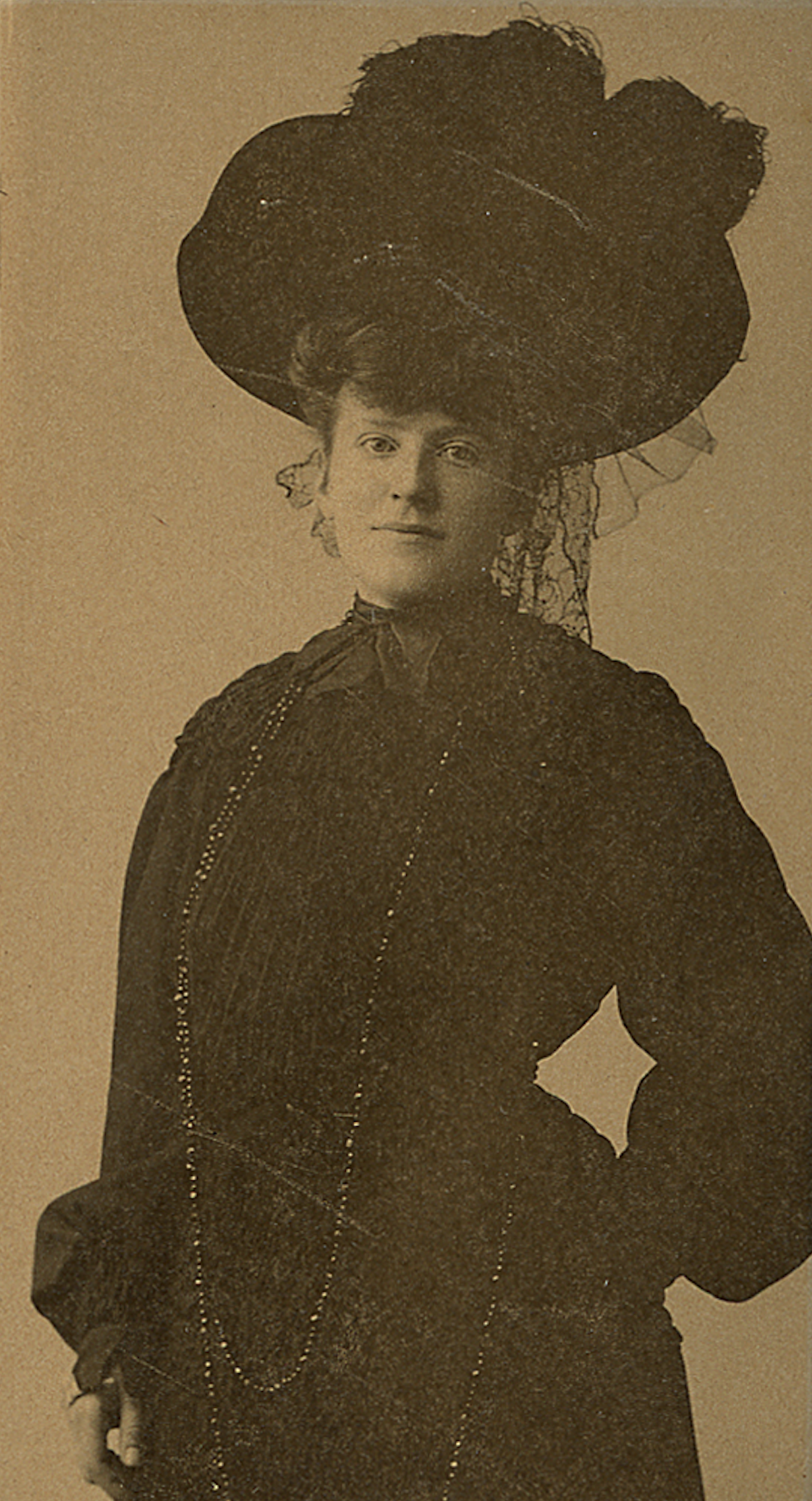
Video: Portrait of a Gibson Girl by early Japanese-American photographer Tokujiro (Henry) Motoyoshi
This is a portrait of a woman made by a Japanese-American photographer named Tokujiro Motoyoshi — who went by the Western name “Henry.”
About photographer Henry Tokujiro Motoyoshi of San Francisco
Photographer Henry Motoyoshi was born — possibly in Japan — on October 5, 1871 and he died February 9, 1963 at age 91. He is buried with his wife Minoru at Evergreen Cemetery in Los Angeles, California.
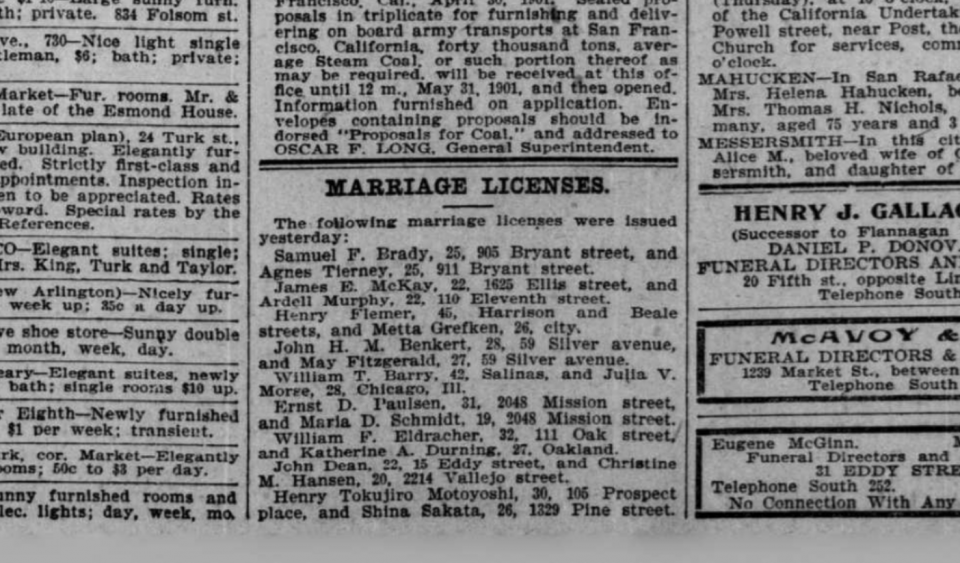
Minoru may have been Henry’s second wife, because I found a marriage license notice in a San Francisco newspaper from 1901 for Henry Tokujiro Motoyoshi, age 30 of 105 Prospect Place, and Shina Sakata, 26, of 1329 Pine Street.
Henry operated his Motoyoshi Portrait Studio in San Francisco for several decades, from the early 1900s until at least the late 1930s.
Several sources say that after surviving the San Francisco earthquake of 1906, Henry quickly reopened his business. His studios were located near San Francisco’s Japantown, and he appears to have catered to a primarily Japanese clientele, but my research did find photographs of non-Japanese customers as well, including the subject of this photograph.
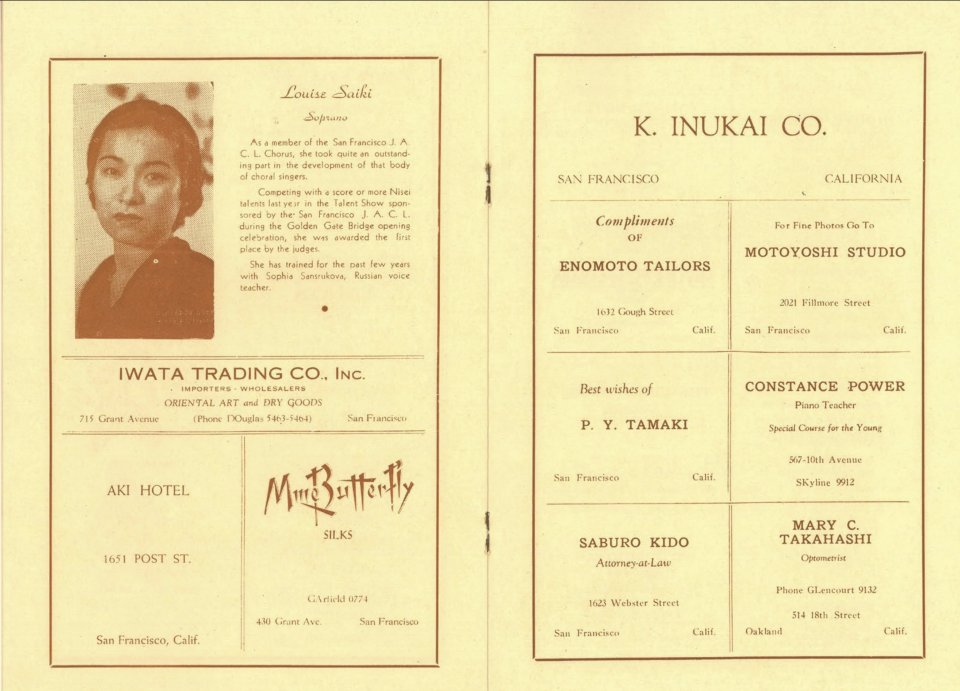
This concert program features a small display advertisement from Motoyoshi Studio, confirming that Henry Motoyoshi was still in business four years prior to the World War II internments of Japanese- Americans. This ad shows his studio address at 2021 Fillmore Street, which appears to be just outside the perimeter of San Francisco’s Japantown area.
Internment in Utah during World War II
Like so many Japanese-Americans, Henry was forcibly relocated to an internment camp for three years during World War II — probably to the Topaz War Relocation Center in Utah. Henry was still in business as late as 1938, but I was unable to confirm that he returned to photography after his three-year internment in Utah.
Information from the library at Loma Linda University suggests that Henry became a Seventh Day Adventist in the 1930s. He may also have worked in an unknown capacity at the Adventist-affiliated White Memorial Hospital for nine years.
About this photograph of a stylish young woman by photographer Tokujiro (Henry) Motoyoshi
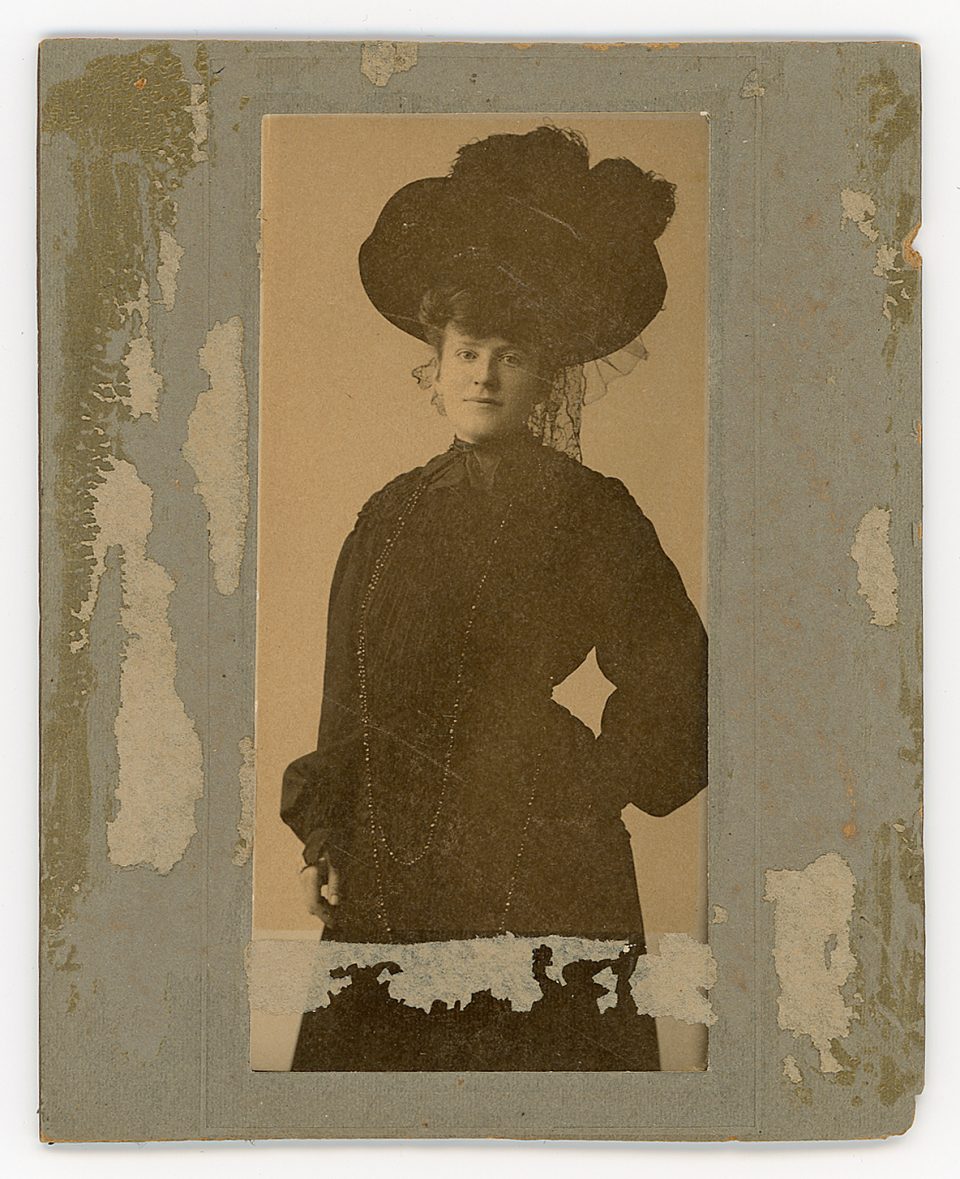
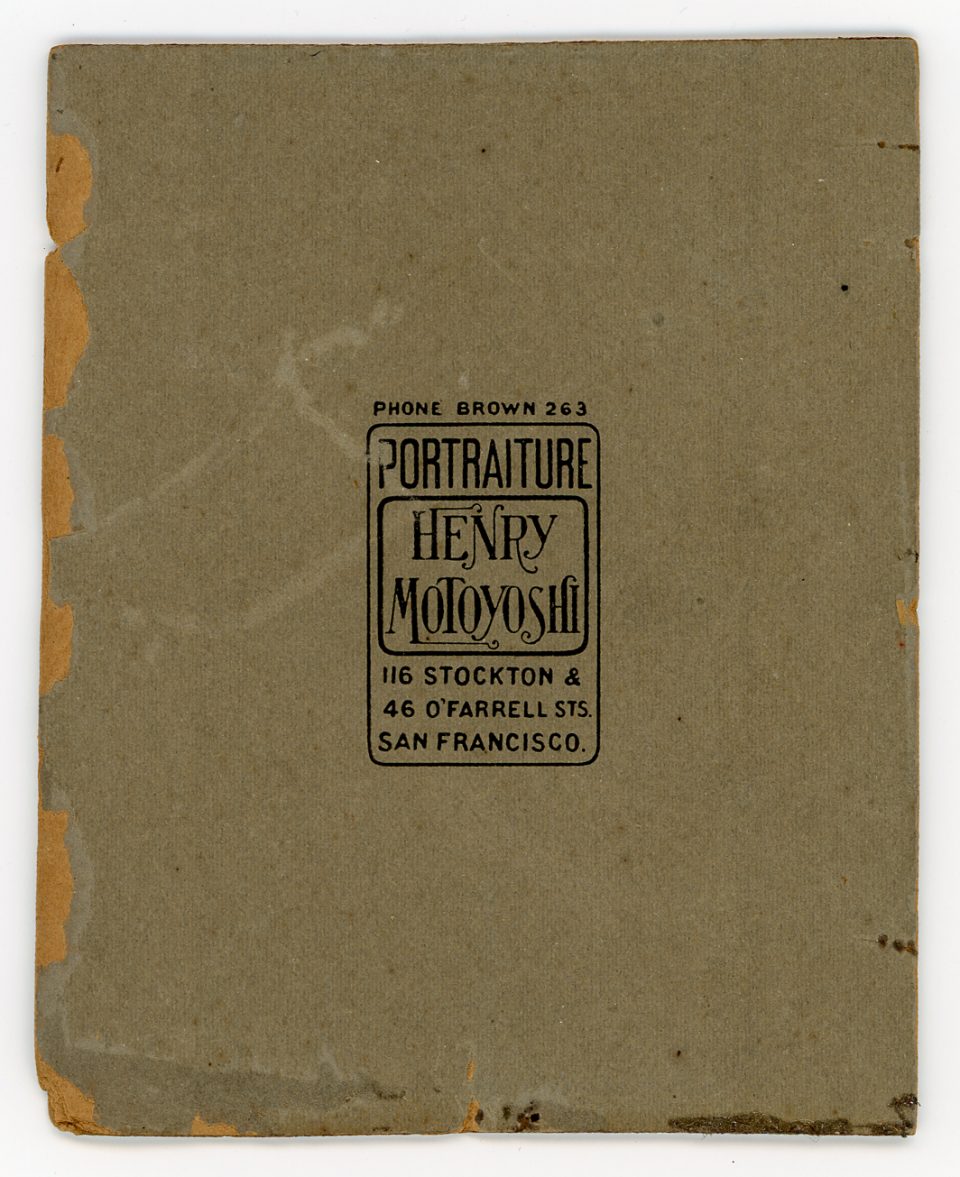
With regards to this photo, it’s a small, yellowed gelatin silver portrait of a beautiful young woman in a big hat. It shows surface damage from torn paper where it was previously adhered to an overmat or something similar.
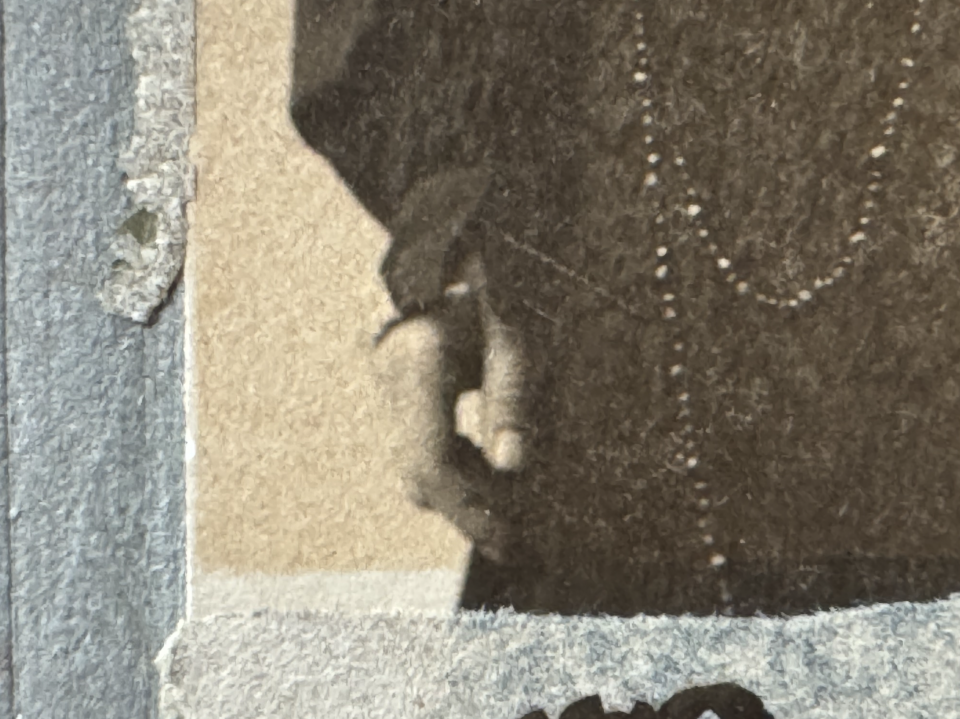
This extreme close-up of the photograph’s surface shows how much the exposed part of the photograph has yellowed, compared to the part that would have been kept in the dark under the mat.
AI analysis of the photograph
I asked AI to analyze and date the photograph and the conclusion was that this photo was probably made sometime between 1905–1910.
AI highlighted fashion clues like the extremely large, wide-brimmed “picture hat,” decorated with a dark plume or feather mass. It said oversized hats like this were popular during the Edwardian era, and were fashionable at their peak around 1908–1911.
Regarding her dress, AI noted its high neckline with structured collar, fitted bodice with fullness at the bust, slightly puffed sleeves at the shoulder (not the dramatic 1890s leg-of-mutton style, which had collapsed by ~1897), and the long beaded necklace wasvery fashionable in the late ’00s)
AI said her silhouette matches the “S-bend” or Gibson Girl era shape (c. 1900–1910).
And finally it said that her hairstyle, swept up in a voluminous pompadour style — called “Gibson Girl hair,” was most common between 1900 and 1912.
The Gibson Girl phenomenon
In researching the Gibson Girl fashion craze, I discovered that it originated in the 1890s and continued on through about 1910. It was named for the illustrator who created it, Charles Dana Gibson. Gibson combined previous feminine ideals of beauty, including the slim fragile lady and the tall curvaceous buxom woman into look that is said to have been potentially the first national beauty ideal for young woman.
Gibson Girls as conceived by the men who created them were independent, equal to men, sometimes teasing. They were upper-class, well dressed, and statuesque. According to Wikipedia, Gibson Girls were portrayed as being in some ways progressive, but were not a particularly political vision of womanhood and were not prone to seeking suffrage for women.
Sources and Links
ChatGPT for date analysis of the photograph
Find-a-Grave. “Tokujiro Motoyoshi.”
https://www.findagrave.com/memorial/9783939/tokujiro-motoyoshi
Lake Sequoia Retreat Archive. “Second Annual NISEI Concert Northern California Y.P.C.C. Gyosei Hall, San Francisco April 2. 1938.” PDF.
https://lakesequoiaretreat.wordpress.com/wp-content/uploads/2017/12/1938-04-01-ncypcc-nisei-concert-2-150ppi.pdf
Library of Congress. The San Francisco Call. “Marriage Licenses.” May 29, 1901. Page 11.
https://www.loc.gov/resource/sn85066387/1901-05-29/ed-1/?sp=11&q=tokujiro+motoyoshi&r=0.227,0.775,0.699,0.537,0
Loma Linda University Library. “Motoyoshi, Tokujiro (Henry) & Minoru.”
https://library.llu.edu/motoyoshi-tokujiro-henry-minoru
Loma Linda University Library. “Seventh-day Adventist Biography File.”
https://library.llu.edu/heritage-research-center/egw-estate-branch-office/seventh-day-adventist-biography-file?page=33
Unique at Penn. “Japan Beautiful.”
https://uniqueatpenn.wordpress.com/2023/06/01/japan-beautiful
Wikipedia. “Gibson Girl.”
https://en.wikipedia.org/wiki/Gibson_Girl
Discover more from Shadows and Light
Subscribe to get the latest posts sent to your email.